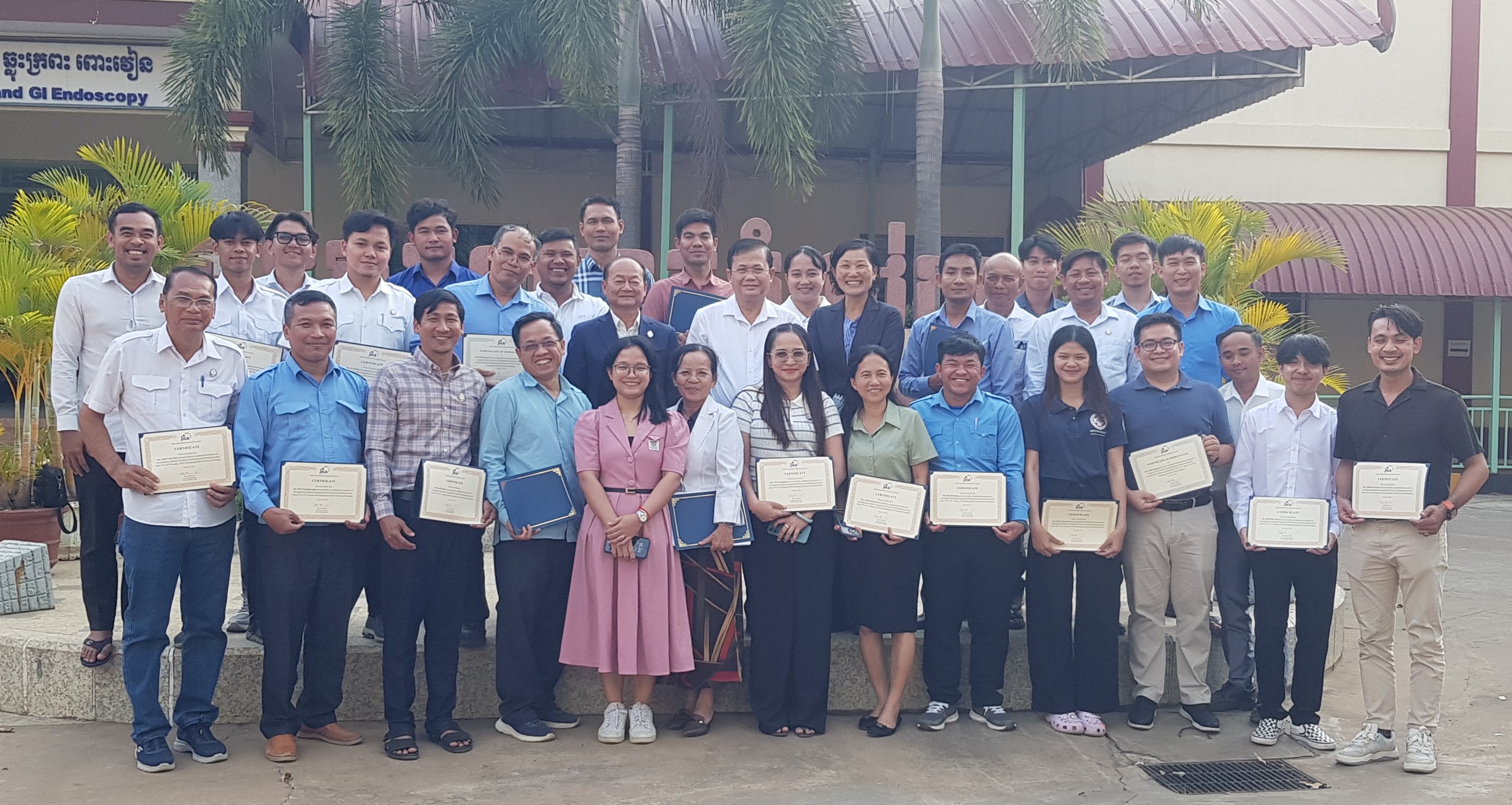
From January 19-23, 2026, I had the privilege of leading a five-day training seminar on medical equipment prevention and maintenance at Kampong Cham Provincial Hospital. This marked my third consecutive year working with JICA Cambodia, and each year brings new insights and rewarding challenges.
The Challenge
When 33 professionals from six provinces gathered in Kampong Cham, they came with a common problem: medical equipment failures disrupting patient care. Cambodia's hospitals face unique challenges - unstable electrical infrastructure, limited maintenance budgets, and equipment that often operates beyond its recommended lifespan. As biomedical engineers, electricians, and finance officers, these participants needed practical solutions they could implement immediately.
A Hands-On Approach
I've always believed that you can't learn equipment maintenance from a textbook alone. This training was built on a "hands-on" philosophy - participants spent their days working directly with patient monitors, ventilators, electrosurgical units, and ultrasound machines.
We used professional-grade testing equipment: electrical safety analyzers to measure ground resistance and prevent microshock, ventilator flow analyzers to verify life-support accuracy, and ultrasound phantoms to detect image quality issues.The most rewarding moments came during practical exercises. Watching an electrician properly measure grounding for the first time, or seeing a BMET successfully calibrate a ventilator's PEEP settings - these are the skills that will save lives and extend equipment lifespan in their hospitals.
Addressing Root Causes
What made this training different was our focus on Cambodia's specific challenges. We didn't just teach maintenance protocols - we addressed why equipment fails here. Electrical instability? We worked on securing critical utilities and proper grounding systems. Limited budgets? Finance officers learned to calculate Total Cost of Ownership and ROI for repairs, giving them the data to justify preventive maintenance programs to hospital administrators.
Knowledge Sharing Across Provinces
One unexpected benefit was the experience-sharing sessions. Participants from Kampong Cham, Banteay Meanchey, Battambang, Svay Rieng, Siem Reap, and Sihanouk provinces discovered they faced similar challenges but had developed different solutions. A ventilator troubleshooting technique from Siem Reap, an electrical safety workaround from Battambang - these exchanges created a network of professionals who will continue supporting each other long after the training ends.
Looking Forward
As H.E. Dr. Kim Sour Phirun, Director of Kampong Cham Provincial Health Department presented certificates to all the graduates alongside Ms. Magafu Naoko from JICA Cambodia Office, I reflected on the impact of this program. These weren't just participants earning certificates - they were becoming ambassadors for equipment safety and preventive maintenance in their hospitals. Cambodia's healthcare system is strengthening, but it requires sustained investment in the people who keep medical equipment running. After three years of training with JICA, I've seen the ripple effects: better-maintained equipment, fewer emergency breakdowns, and most importantly, improved patient safety. This training reminded me why I chose this field. When a biomedical engineer prevents an equipment failure, when an electrician ensures proper grounding, when a finance officer secures budget for preventive maintenance - these aren't just technical achievements. They're contributions to a healthcare system that serves millions of Cambodians.